Sunday, 19 June 2011

Urban Decay Phenomena in South East Asian Cities


Ultimately, all cities are in a state of continuous transformation and experience periods of growth and decline, both of which lead to transformation of urban space from one economic and social use to another. Transformation put these cities continually in the process of becoming larger, smaller, better, or worse—in one way or another, different than they were in the past. This process of continual transformation occurs partly in response to the political, social, economic, and industrial changes as cited by Middleton (1991). Decay of inner urban space often occurs within the context of such transformation. According to Clark (1989), inner urban decay, crime, racial tension, riots, mass unemployment, and falling standards in the provision of urban services are some of the more obvious and disturbing indicators of a general and deep-seated deterioration in the social, economic, political, and financial fabric of a city. Middleton (1991) points out that such decay leads to out-migration of younger and more skilled members of urban populations as they seek employment elsewhere. The result is that, the population trapped in inner-city areas tends to mainly comprise single parents, unskilled workers, and elderly persons.

Urban decay is the process whereby a previously functioning city, or part of a city, falls into disrepair and decrepitude (Grogan & Proscio, 2001). Urban decay is akin to the lingering death of a place, in which socioeconomic conditions evolve and opportunities may disappear for the citizens of the place to survive the transformation. Consequently, many people are forced to disassociate themselves from the place and leaving it in a state of disrepair. Urban decay occurs when a part of a city falls into disrepair and abandonment.  Features of a decaying urban place can be in the form of deindustrialization, high unemployment rates, high crime rates, depopulation, desolate-looking landscapes, abandonment of buildings and poor infrastructure. Another characteristic of a decaying urban place is blight – the visual, psychological, and physical effects of living among empty lots, buildings and abandoned houses. Such desolate properties are socially dangerous to the community because they attract criminals and street gangs, contributing to the volume of crime. Urban decay does not have one single cause, but rather a combination of many, including poor urban planning, redlining, poverty, suburbanization and lack of political will to maintain the area into being a decent place to live in. Most of these factors arise as a result of imbalanced socioeconomic conditions, which led to the scarcity of job and economic generator opportunities, thus making most citizens to move away in search of new opportunities. The few citizens who are left behind may compete for scarce opportunities, and seek to draw welfare benefits. This phenomenon inevitably resulted in broken and selfish communities.

Most urban centers in South East Asian countries with market-based economies are often provided with a disproportionate state allocation of human and financial resources. Furthermore, population growth and increasing affluence generated demands for rapid physical expansion of these areas (Lim, 1998). However, most of these urban centers are still not able to accommodate such demands, thus causing unregulated growth and expansion. Where land and financial resources are not well allocated, slums and squatters exist, and led to urban decay. An ideal and healthy city should provide its inhabitants with sufficient space and service. The ratio of space provided should be in balance with the number of the populations. Linkages of places through the provision of good and reliable transportation and public services is important, and the most important function of a good city is to provide the best possible environment and quality of life for everyone who is living and working there. However, this ideal city is rarely found in most South East Asian countries due to many reasons. Such reasons include:

1.     Settlement problems due to the lack of efficiently allocated space and concentration of the population.
2.     Increasing informal sectors, which resulted in influx of low skilled migrants to the city center.
3.     Poor allocation and maintenance of public services and infrastructures.
4.     Wasteful new developments that is not responsive to the real needs of the city’s inhabitants. (i.e. over development of gigantic shopping malls, developments on gazetted public and green areas, etc.)
5.     Inefficient water and waste management systems.
6.     Unsuitable planning policies that fully adopted Western models without any alteration and improvisation to suit local contexts.
7.     Unregulated modification of the built environment that does not respond to the behavioral patterns and culture of the local community.
8.     Weakness in political will and implementation of by-laws and regulations.


In most cases in South East Asian cities, modern developments have transformed historic urban centers into fragmented building blocks that disregard the unique townscape of the place. Sites of dilapidated buildings have been the target for new buildings and often are mediocre in design quality, which fail to respond to the sense of place and its surrounding context. From previous literatures, urban regeneration also includes various definitions that emphasize on different aspects of it. In general terms, it is defined as “a comprehensive and integrated vision and action, which leads to the resolution of urban problems, and which seeks to bring about a lasting improvement in the economic, physical, social and environmental condition of an area that has been subjected to changes” (Roberts, 2000).  Roberts also classified major aims of urban regeneration into the following five elements:

1.     The relationship between the physical conditions of urban space and social deprivation.
2.     The need to attend to matters of housing and health in urban areas.
3.     The attractiveness of linking social improvement with economic progress.
4.     The containment of urban growth.
5.     The changing role and nature of policy.

*Photos above showing the state of decay around the area of Jl. Jenderal Sudirman in Bandung, Indonesia (taken June 2011).

Thursday, 9 June 2011

World Architect Series by IAI Nasional - Guest Lecture by Rem Koolhaas


Continuing the World Architect Series Program, jongArsitek! and Ikatan Arsitek Indonesia Nasional presents a guest lecture by Rem Koolhaas.

Venue: Blitz Megaplex, 8th Floor West Mall, Grand Indonesia, Jakarta, Indonesia
Date: Monday, June 20, 2011
Time: 1530 WIB
Free Entry, please call 021 5304715 or 021 5304722 for reservations. 

*Event and poster courtesy of jongArsitek! and IAI Nasional.

Sunday, 5 June 2011

Regeneration of Decaying Urban Place Through Adaptive Design Infill


Unregulated transformations caused by expansion of population growth, users’ needs and demands, uncontrolled land and building use conversion, lack of attention towards public spaces, facilities and amenities, low level of maintenance and so on caused an urban place to experience decay. The decaying of a place thus lead to many negative issues and problems for a place, which include the declining in living quality standards, exodus of population to different places, under utilized spaces and lands, high crime rate and poor economic condition, even though the place have all the potential to be develop as a good urban place worth living in. This thesis look at these issues by conducting a comprehensive study on the phenomena of urban decay along and within the area of Jalan Jenderal Sudirman, and try to respond to the issue through the proposal of regeneration. Urban regeneration is seen as the most suitable approach to provide feasible solution in re-installing the quality of the area into becoming a more adaptable, sustainable and livable place to live, work and play. The proposed regeneration initiative utilizes all potential available at the site, thus adaptive reuse and design infill development are seen as the most suitable approach in doing so. The regenerated scheme also responds to the social, cultural and economical context of the place, and uses the platform of home industry and cultural tourism to stimulate activities and becoming the economic generator for the site. The crux of this thesis is to understand the phenomena of urban decay caused by urban transformations, and see how urban regeneration initiatives can respond to the problem. It is hoped that from the proposed scheme of this thesis, new hope and visions to elevate the living quality standard for Bandung can be achieved in a clear, feasible and sustainable way. 


Tuesday, 24 May 2011

Studium Generale SAPPK Institut Teknologi Bandung 2011


Information are correct at time of upload. Please visit ADRG's website for latest updates.

*Poster design by Prathiwi Widyatmi

Thursday, 19 May 2011

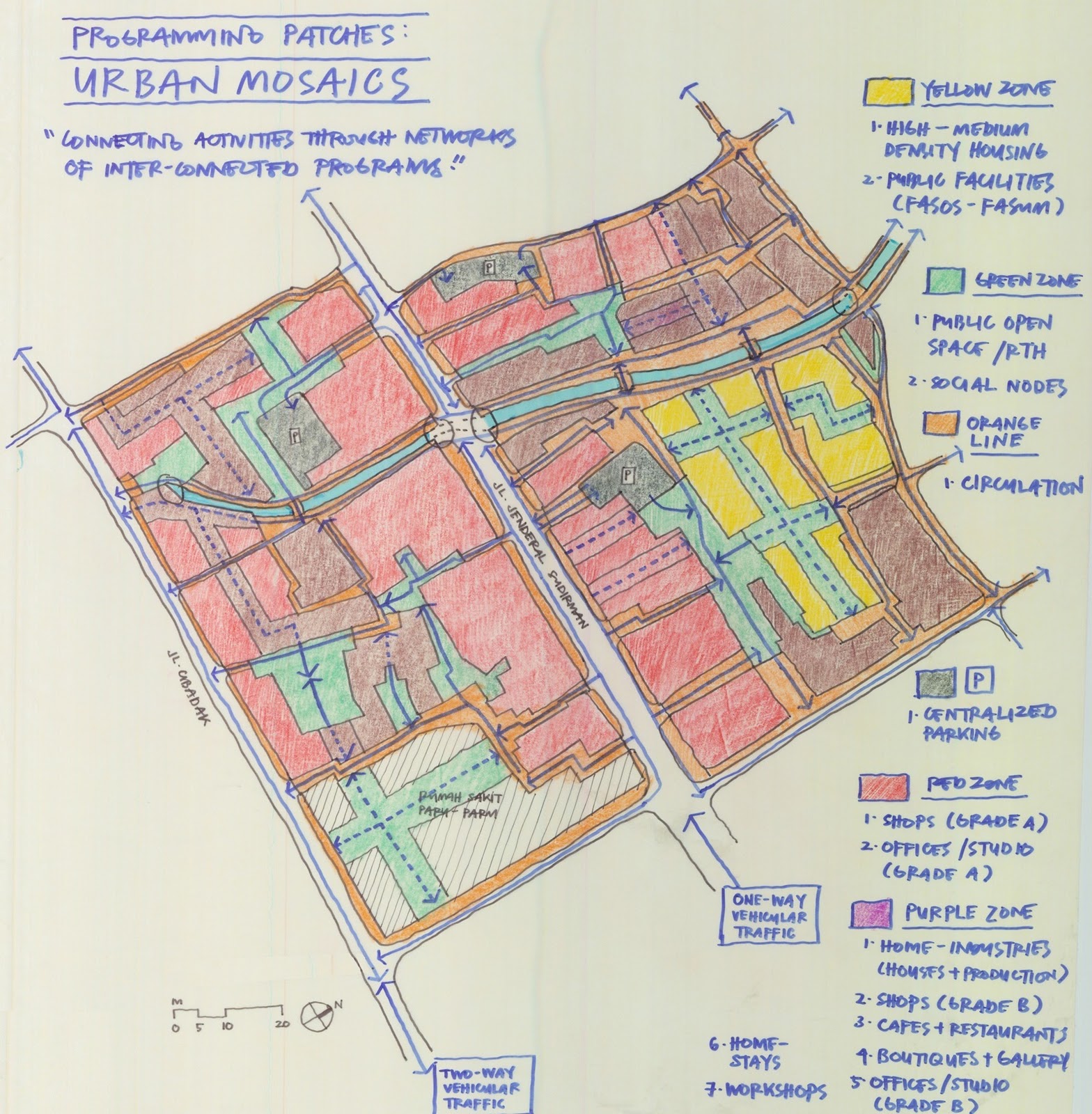
Urban Regeneration of Kampung Kriya Sudirman - Drawing Diagrams


The hypothesis is that the creation of a social catalyst as an integral part of the environment will aid mediated communication between spaces by providing a spark to initiate conversation and the interest to sustain it. One way to create this is through the provision of ample and well-designed public spaces into the neighborhood. On the urban scale, strategically positioned public open spaces will act as the catalyst to promote social cohesion between local citizens, and with the neighboring context of the city. Provision of these inner green pockets in the city will offer alternative spaces for citizens to embark on the many positive outdoor activities, which range from specific activities to casual ones. Complimenting the public spaces are architectural strategies that focuses on how architectural interventions can activate and contribute to the process of regeneration. Territorial and urban infrastructures, urban analysis and scenarios, programmatic and typological hybrids and the mutation of the built environment form the input for architectural thinking and design. The regeneration plan work on strategic places with interesting potential not yet or not fully utilized. These areas are often disconnected to the urban fabric and therefore becoming unattractive. The aim of the intervention is to position architecture to react on the physical as well as the cultural context in the effort to improve the performance of the area’s spaces. By overlaying a variety of uses and people onto the area, creating variety of thematic corridors and strips the plan is able to create a more diverse and distinct urban condition. Placement of basic urban components such as shops, boutiques, restaurants, cafes, hostels for budget travelers, book shops, groceries and markets, etc, weaves together layers of social classes and stitch the separated land clusters into becoming a unifying area with interesting concepts and themes. These components also blur the accepted boundaries of public and private spaces through its networks of circulation. These architectural components are designed in a performative manner, which include the elements of action, performance, event, surprises, etc in the area. The performative quality of the intervention is intended to influence – permanently or temporarily other agents in the urban place.

Public Initiatives: Gotong Royong Pulosari


Saturday, 14 May 2011

Urban Regeneration of Kampung Kriya Sudirman - Study Models


The area of intervention, as a scale of architectural design, manifests series of assumptions and limitations. The planned regeneration initiative is not a singular act; it entails a series of multiple contingencies and constituencies. These circumstances include not only questions of how to address the site’s problems, but also issues of how to respond to the problematic conditions of the area, that is how architectural designs can be implemented at such scale, and what claims of effectiveness does this implies. Given the architectural interventions’ general ambition is to re-create and regenerate the sense of quality of life for the site’s currently decaying state of condition, within the framework of contemporary urbanism, consideration of the area’s and its contextuality with the city presents a terrain of continual definition, initiated with new information, contexts and contingencies. As the architectural intervention propositions imagines itself at a larger scale of the area, namely, that of the city context, it must acknowledge that the city context demand multiplicity and pluralistic, mostly beyond the singularly architecture’s ability – most importantly, consolidating all the issues stated from the analysis, uncovers the particular question of how architectural interventions in this relative immediacy can invoke the temporal accumulations of the site conditions that are associated with the city.   


Monday, 25 April 2011

Saturday, 2 April 2011

Diskusi 'I am Always Stammering!' Vol.1


‘I am Always Stammering!’ Vol.1 was successfully conducted at The Painting Garage on Friday, March 25, 2011. The discussion session was dedicated to collect funds to assist the construction of temporary shelters for the March 2011 earthquake and tsunami victims in Japan. Funds collected from the event were donated through a collective network that support the initiative of Shigeru Ban – the architect whom is designing the temporary shelter units. The discussion attracted audiences, not only within the arts and architecture community, but also crowds from other disciplines that include film and music critics, law, language and cultural studies, media and writing and others. A big group of Japanese residing in Bandung also attended and donated during the event, and not to forget the big support we received from Sushi Tei.

The discussion theme was loosely structured to invite audiences to share and discuss their understanding and thoughts on the issue of being a stammerer – which can be loosely interpreted within the context of language, narrative, ideas and ways of working things and one’s thought. The event started with a projection of visual narratives from Jean-Luc Godard’s latest works, Film Socialisme that then drove the stammerer of the night, Kumiko Homma(1) into the topic of creative stammering. She relates creative stammering with a statement from Gilles Deleuze who described Godard as always being a stammerrer, but not stammering in his words, but stammering in the language itself. Kumiko described herself as being a foreigner actually brought many positive insights for her to not only understand, but expressed something by viewing things from the perspective that locals or people who are used to a certain context can’t. She again borrowed Deleuze’s text that support creative stammering as a powerful tool in the process of learning and creativity, “to be a foreigner not in another language but in your own language...only creative stammering can make a force..”

Taking the discussion to the context of architecture and art, Kumiko then presented some of her researches that studied the work of Junya Ishigami, the young avant-garde Japanese architect, as well as works and teaching method of Shin Egashira, a diploma unit master at the AA School of Architecture, which has also taken similar curious approaches. Henry Gunawan(2) supports the presentation with some architectural and design aspects of the works, making a more concrete and clearer statement on how creative stammering and the in-between-ness of art and architecture can also be a valid approach in the context of making good and interesting built environment. David Hutama(3) then brought the audiences into the discussion of being a stammerer by providing information and facts that connected the gap between Godard, Ishigami and Egashira and took the discussion into the context of Indonesia. Being a stammerer himself while becoming an Indonesia student living in Japan, David viewed the issue from the other side that Kumiko had not noticed while being a Japanese living in Indonesia. This is also the case with Henry and Hafiz Amirrol(4), whom both had experienced living outside of their own country and became stammerers themselves.

Asti Goenawan(5) brought some of her beautiful paintings to The Painting Garage and shares her experience of becoming the painting lawyer. Not having a formal training as a painter, Asti developed her painting skills through observation, influences and experience. In her case, she is experiencing creative stammering not in the context of geographical, cultural and social differences, but as someone who is stammering in a discipline that she was not trained in. Hafiz also presented some of his works that have strong roots in the field of fine arts, which he developed through his formal training as an architect. Adding to those presentation, Reza Ismail, an urban architect that religiously is also a music collector gave some of his insights, which then brought Tata Soemardi, an assistant professor and practicing urban designer that has practiced in the United States, Europe and Asian countries to share some of his personal thoughts on working in foreign land and coming back to his hometown Bandung. Ade Tinamei who is also a practicing urban designer gave some added notes on her travelling experience that was a mixed between heaven and hell.


Click here for further reading on a note by David Hutama.


*Stamerrer, Moderator and Discussants:
1. Kumiko Homma is a PhD candidate in Comparative Civilizations Studies and has been living in Bandung for three years. A big fan of Schoemaker, Deleuze and Rossi? No, she is just a Stammerer!

2. Henry is a practicing architect, graduated from Columbia University and the Ohio State University. He is the principal of HGT Architects, and has worked on numerous projects in Indonesia with experiences in prestigious New York architecture firms. Some of his current works include residential and commercial projects, as well as participating in international conferences and exhibitions.

3. David is an architectural and urban historian by training. His latest writing "Ruang Publik dalam Arsitektur" has been published in a book titled "Wacana tentang Ruang Publik" edited by F. Budi Hardiman. David teaches at Universitas Pelita Harapan and is currently the Head of the Architecture Department.

4. Hafiz is the writer of this blog.

5. Asti loves to paint since she was a child. Graduated from the Faculty of Law, Universitas Parahyangan Bandung, Asti is a self-trained painter. She had her first solo exhibition in July 2010, entitled "In Her Comfort Zone", followed by a second one, "The Tales of Purple" in August 2010 at Jakarta.

*Photos courtesy of Sarah Permana Martakoesoemah and Kumiko Homma

Public Lecture Series SAPPK Institut Teknologi Bandung 2011


Information are correct at time of upload. Please visit ADRG's website for latest updates.

Sunday, 27 March 2011

Regeneration of Decaying Urban Place Through Adaptive Design Infill


The state of urban and architectural decay has always been a classic case in most urban centers of Asian cities. The center of a city usually always displays urban decays , because development is concentrated too much in these areas. Seeing this almost ubiquitous phenomenon, radical examination and re-assessment on all the planning and design principles that we have used until now is needed. However, there will be no single and definite answer to how city planning for the future should be, but there will only be many options that must be carefully selected before being implemented in each different context of a place. Many urban places in Bandung have experienced unprecedented growth, urban growth and radical changes in recent years. In the process, much of the traditional urban areas have been either damaged, destroyed or badly mutilated, with policy makers often arguing that conserving these areas as being a luxury, which emerging economies can ill afford during the early stages of their development. This is what exactly had happened, and will continue to happen to the downtown area of Jalan Jenderal Sudirman and its surroundings. Once was one of the most important district in Bandung, with all of its potential and rich tissue of urban components, the area is being left to suffer decay and lack of attention, both from policy makers and those involved in the industry of built environment. Click here to read more.

Search